

This post may contain affiliate links at no additional cost to you. As an Amazon Associate I earn from qualifying purchases. Click to view our full disclosure.
What's inside
Want a workout plan that tells you exactly what to do on every day of the week? This 7 day plan does just that, from Monday’s squats to Sunday’s recovery walk.
Here’s the twist: only four of the seven days are lifting days. The other three are cardio and recovery, and that’s what lets you keep showing up week after week without running yourself into the ground.
It’s built for men and women who’ve been lifting for at least six months and want their whole week at the gym mapped out. Keep reading for every session, how to progress over six weeks, and the signs you need an extra rest day.
The plan at a glance
| Level | Intermediate (6+ months of regular lifting) |
| Days | 7: 4 lifting, 2 cardio, 1 recovery |
| Lifting sessions | 40-50 min, 5-6 exercises |
| Cardio sessions | 20-40 min |
| Recovery day | 30-60 min walk, then 10 min of stretching |
| Rest between sets | 2-3 min on the first lift, 60-90 sec on the rest |
| Length | 6 weeks, then repeat |
| Equipment | Commercial gym |

Your week
| Day | Session | Time |
|---|---|---|
| Monday | Lower A: squat focus | 40-50 min |
| Tuesday | Upper A: bench and row | 40-50 min |
| Wednesday | Steady cardio and core | 40 min |
| Thursday | Lower B: deadlift focus | 40-50 min |
| Friday | Upper B: press and pull-up | 40-50 min |
| Saturday | Intervals | 20-30 min |
| Sunday | Recovery walk and stretch | 40-70 min |
You train your legs twice and your upper body twice. Your legs never get two hard days in a row, and there’s always at least a day between sessions for the same muscles.
The first exercise on each lifting day is your main lift, done heavy for sets of 5. Everything after it is an accessory, or a smaller exercise that fills in the gaps, done for more reps.
The workouts
Monday: Lower A
| Exercise | Sets | Reps |
|---|---|---|
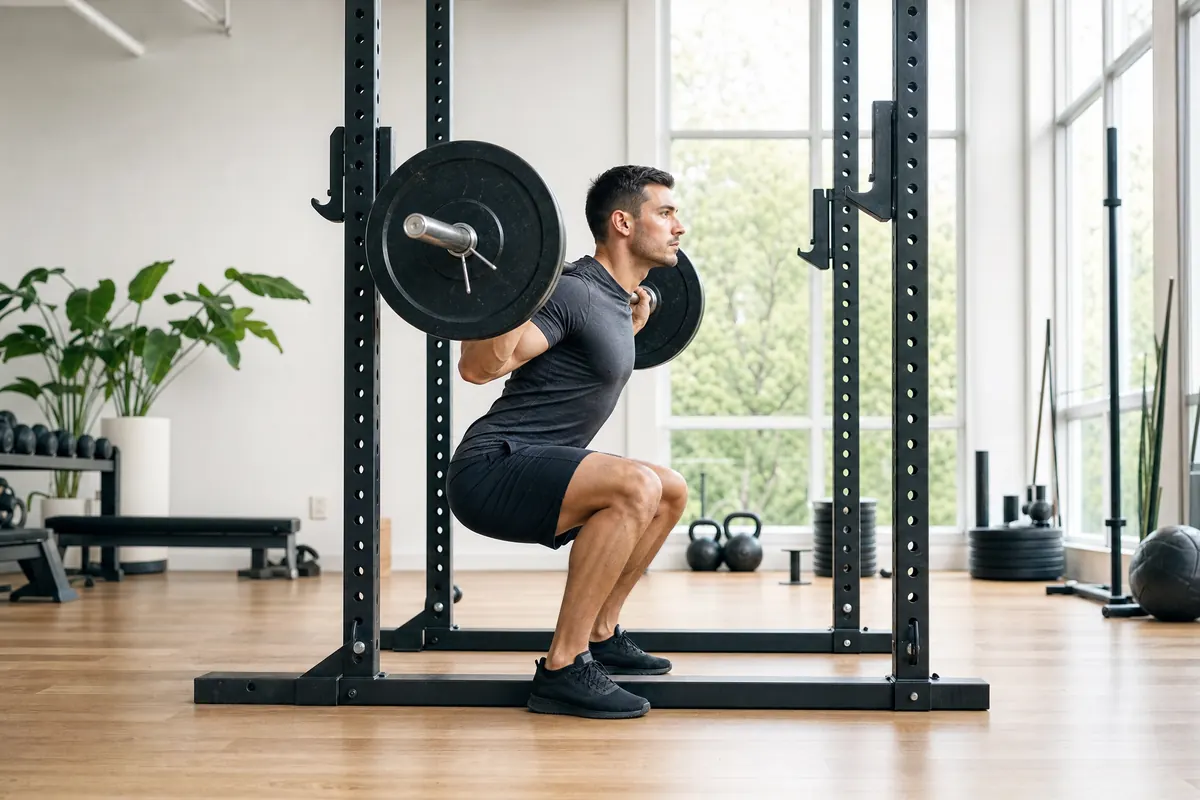
| Barbell back squat | 4 | 5 |
| Romanian deadlift | 3 | 8 |
| Walking lunge | 3 | 10 each leg |
| Leg curl | 3 | 10-12 |
| Standing calf raise | 3 | 10-12 |
| Hanging knee raise | 3 | 10-12 |
A Romanian deadlift starts standing, with the bar in your hands. You push your hips back and slide the bar down your thighs with a slight bend in your knees, then stand tall again. It works your hamstrings and glutes.
Tuesday: Upper A
| Exercise | Sets | Reps |
|---|---|---|
| Barbell bench press | 4 | 5 |
| Barbell row | 4 | 6-8 |
| Incline dumbbell press | 3 | 8-10 |
| Lat pulldown | 3 | 8-10 |
| Dumbbell curl, supersetted with triceps pushdown | 2 + 2 | 10-12 |
A superset means doing two exercises back to back, then resting.
Wednesday: steady cardio and core
Spend 30 minutes on the bike, rower or elliptical, or walking on an incline treadmill. Keep it at a talking pace, or an effort where you’re breathing harder but could still speak in full sentences. Then finish with this core circuit:
| Exercise | Sets | Reps |
|---|---|---|
| Dead bug | 3 | 8 each side |
| Side plank | 3 | 30 sec each side |
| Pallof press | 3 | 10 each side |
A dead bug is done lying on your back with your arms and knees in the air. You slowly lower the opposite arm and leg while keeping your lower back pressed into the floor.
A Pallof press uses a cable or band at chest height. Stand side-on to it, press your hands straight out in front of you, and hold steady so the cable can’t twist you.
Thursday: Lower B
| Exercise | Sets | Reps |
|---|---|---|
| Deadlift | 3 | 5 |
| Leg press | 3 | 10-12 |
| Bulgarian split squat | 3 | 8-10 each leg |
| Leg extension | 2 | 12-15 |
| Seated calf raise | 3 | 12-15 |
| Cable crunch | 3 | 12-15 |
A Bulgarian split squat is a one-leg squat with your back foot resting on a bench behind you.
Friday: Upper B
| Exercise | Sets | Reps |
|---|---|---|
| Standing overhead press | 4 | 5 |
| Pull-up or assisted pull-up | 4 | 6-10 |
| Dumbbell bench press | 3 | 10-12 |
| Seated cable row | 3 | 10-12 |
| Dumbbell lateral raise | 3 | 12-15 |
| Cable face pull | 2 | 12-15 |
A face pull uses a rope on a cable at face height. You pull it toward your forehead with your elbows high, which works your upper back and the backs of your shoulders.
Saturday: intervals
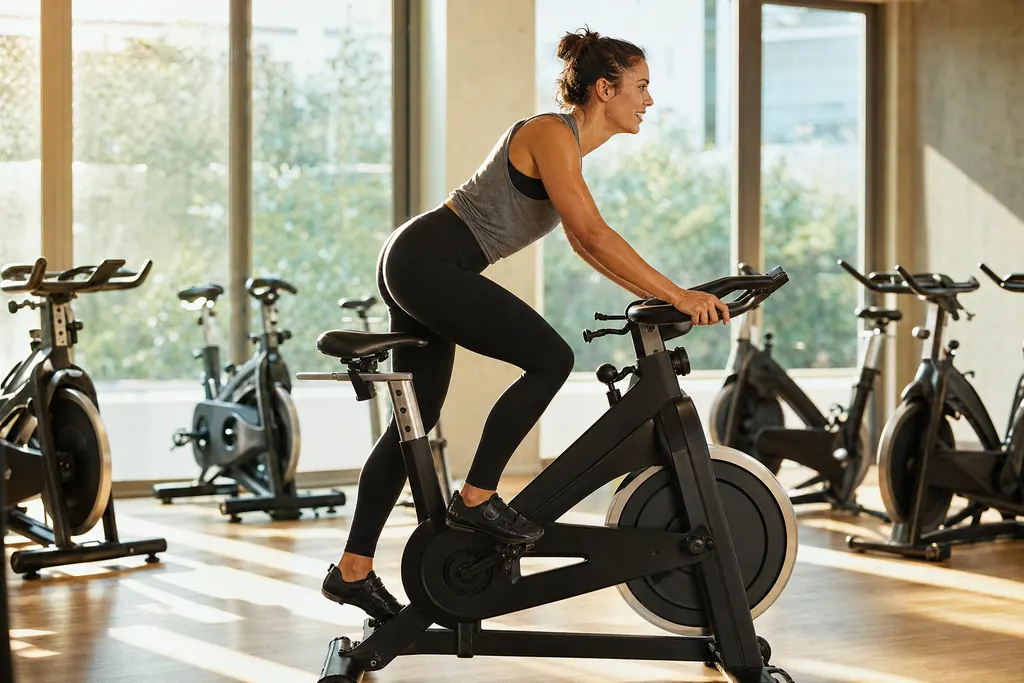
Use a bike or a rower.
| Part | Time |
|---|---|
| Easy warm-up | 5 min |
| 1 min hard, 1 min easy | 6-10 rounds |
| Easy cool-down | 5 min |
“Hard” means about 8 out of 10 effort, where you can only get out a word or two. Start with 6 rounds in week 1 and add one round a week.
Sunday: recovery walk and stretch
Take an easy 30 to 60 minute walk, outside if you can. Then spend about 10 minutes stretching the spots that feel tight, like your hips, hamstrings and chest. Hold each stretch for 30 to 60 seconds.
Feeling run down? Make Sunday a full rest day instead. That’s exactly what it’s there for.
How to pick your weights
Main lifts: choose a weight you could lift 6 or 7 times, so every set of 5 ends with a rep or two left in the tank. “Reps in the tank” just means how many more reps you could have done with good form.
Accessories: pick a weight that gets you into the rep range with 1 to 3 reps in the tank. Sets should feel hard by the end, but your form should never fall apart.
How to progress over 6 weeks
| Weeks 1-2 | Weeks 3-5 | Week 6 | |
|---|---|---|---|
| Effort | 2-3 reps in the tank | 1-2 reps in the tank | Easy |
| Sets | As listed | As listed | Half the sets |
| Saturday intervals | 6-7 rounds | 8-10 rounds | 5 rounds |
When to add weight
The American College of Sports Medicine suggests adding 2 to 10% to the load once you can do one or two reps more than your target. On your main lifts, that means every set of 5 felt like you had 6 or 7 in you. On accessories, it means beating the top of the rep range on every set.
In practice, that’s usually 5 lb (2.5 kg) on upper body lifts and 10 lb (5 kg) on squats and deadlifts. On dumbbell moves, go up to the next pair.
Week 6 is a deload
A deload is an easier week. Keep the same weights but do half the sets. Then start the next 6 weeks a little heavier than you began the last ones.
Why not lift all 7 days?
Because more lifting days don’t automatically mean more muscle.
A 2019 review of 25 studies found that when the total number of sets was the same, training a muscle more often didn’t make a meaningful difference to growth. What matters most is the total work you get through across the week, and four well-planned sessions give you plenty of room for it.
That lines up with the American College of Sports Medicine’s guidance. It suggests 3 to 4 lifting days a week for intermediate lifters and 4 to 5 for advanced lifters. Seven isn’t on the list.
Recovery is the other half of the deal. A joint statement from the European College of Sport Science and the American College of Sports Medicine puts it simply: good training needs hard work, but hard work plus too little recovery is the combination to avoid.
Signs you need an extra rest day
That same statement lists fatigue, a drop in performance and mood changes as common signs that training is outpacing recovery. Watch for:
- feeling tired all the time
- your main lifts stalling or going backward for a few sessions in a row
- feeling unusually low, flat or irritable
If that sounds like you, swap your next lifting day for an easy walk, then eat and sleep well. The statement also flags eating too little overall, or too little carbohydrate and protein, as things that can play a part. If the signs don’t lift after a few easy days, check in with your doctor.
Will the cardio days hurt your gains?
Probably not! A 2022 meta-analysis of 43 studies found that adding cardio to strength training didn’t reduce muscle growth or maximal strength. The one thing that took a small hit was explosive strength, and mostly when cardio and lifting were done in the same session. That’s why this plan gives cardio its own days.
Cardio is great for your health too. The WHO recommends strength work for all your major muscles on 2 or more days a week, plus aerobic activity like walking, running or cycling. For the aerobic part, that works out to five 30 to 60 minute sessions a week at a moderate pace.
Your four lifting days have the strength part covered. Wednesday, Saturday and Sunday get you part of the way on the aerobic side, and a brisk walk on two or three of your lifting days helps close the gap.
Why heavy sets of 5 and longer rests?
Each lifting day starts heavy, then moves to moderate reps. A meta-analysis of 21 studies found that heavy loads built more maximal strength, while muscle growth was similar across light and heavy loads. So you get strong on the main lifts and build muscle with everything else.
Rest matters on those heavy sets. When researchers compared 1 minute and 3 minute rests in trained young men, the 3 minute group got stronger and built more thigh muscle. It was a small study of 21 men, so hold it loosely, but there’s no reason to rush your heavy sets.
Eating for it
You’re active every day, so fuel it. Aim for about 0.6 to 0.9 g of protein per pound of bodyweight a day (1.4 to 2.0 g per kg), spread across your meals. If you want to build size, eat a little more than you burn. Our list of the best foods to gain muscle is a great place to start.
Questions people ask
Is it okay to work out 7 days a week?
Yes, as long as most of those days aren’t hard. In this plan only four days are lifting days, and Sunday is easy on purpose. Moving every day is great. Lifting hard every day leaves very little room for recovery, which is the exact combination the overtraining statement warns against.
I’m new to the gym. Should I start here?
We’d start with our 7 day gym workout plan for beginners instead. Come back to this one after about six months of steady lifting.
Can I lift five days instead of four?
You can, if you’re recovering well. Try a 5 day workout split and keep Sunday as your recovery day.
What if I miss a day?
Pick up where you left off and push the rest of the week back a day. If the week gets squeezed, drop a cardio day before you drop a lifting day, and never stack the two lower body days back to back.
Can I do the cardio days at home?
Absolutely. A brisk walk or a jog works for Wednesday, and our no equipment home cardio workout is a good swap for Saturday’s intervals.
Can women do this plan?
Of course! It works the same way for anyone. Just scale the weights to you.
Happy training, and enjoy having your whole week planned out!
This article is for general information and is not medical advice. If you have an injury or a medical condition, check with a doctor before starting a new training plan.
