

This post may contain affiliate links at no additional cost to you. As an Amazon Associate I earn from qualifying purchases. Click to view our full disclosure.
What's inside
Ever wished eating healthily could be a little simpler? Two meals a day might be just the thing.
This is a 7 day meal plan for eating two meals a day. Every meal comes with portions, approximate calories and protein, so you know exactly what to put on your plate. Each day comes to about 1,500 to 1,600 calories and 90 to 115 g of protein, and we’ll show you how to scale it up.
So why would you do it? Here’s the honest answer: two meals a day is a simple way to eat fewer calories, if it suits your life. Fewer meals to plan, no grazing, no snacking.
It isn’t a metabolic trick, and the research section below explains why that’s completely fine.
Check with your doctor first if you take medication for diabetes (especially insulin, or tablets such as gliclazide or glimepiride, where missing or delaying meals can cause low blood sugar), you are pregnant or breastfeeding, you have a history of disordered eating, or you are under 18.
The plan at a glance
| Meals | 2 a day, roughly 6 to 8 hours apart |
| Calories | About 1,500 to 1,600 a day (scaling table below) |
| Protein | About 90 to 115 g a day, 45 to 65 g a meal |
| Typical timing | 10am and 5pm, or 12pm and 7pm |
| Drinks | Water, black coffee, tea. Any time |
| Best for | People who are not hungry in the morning, or who like big meals |
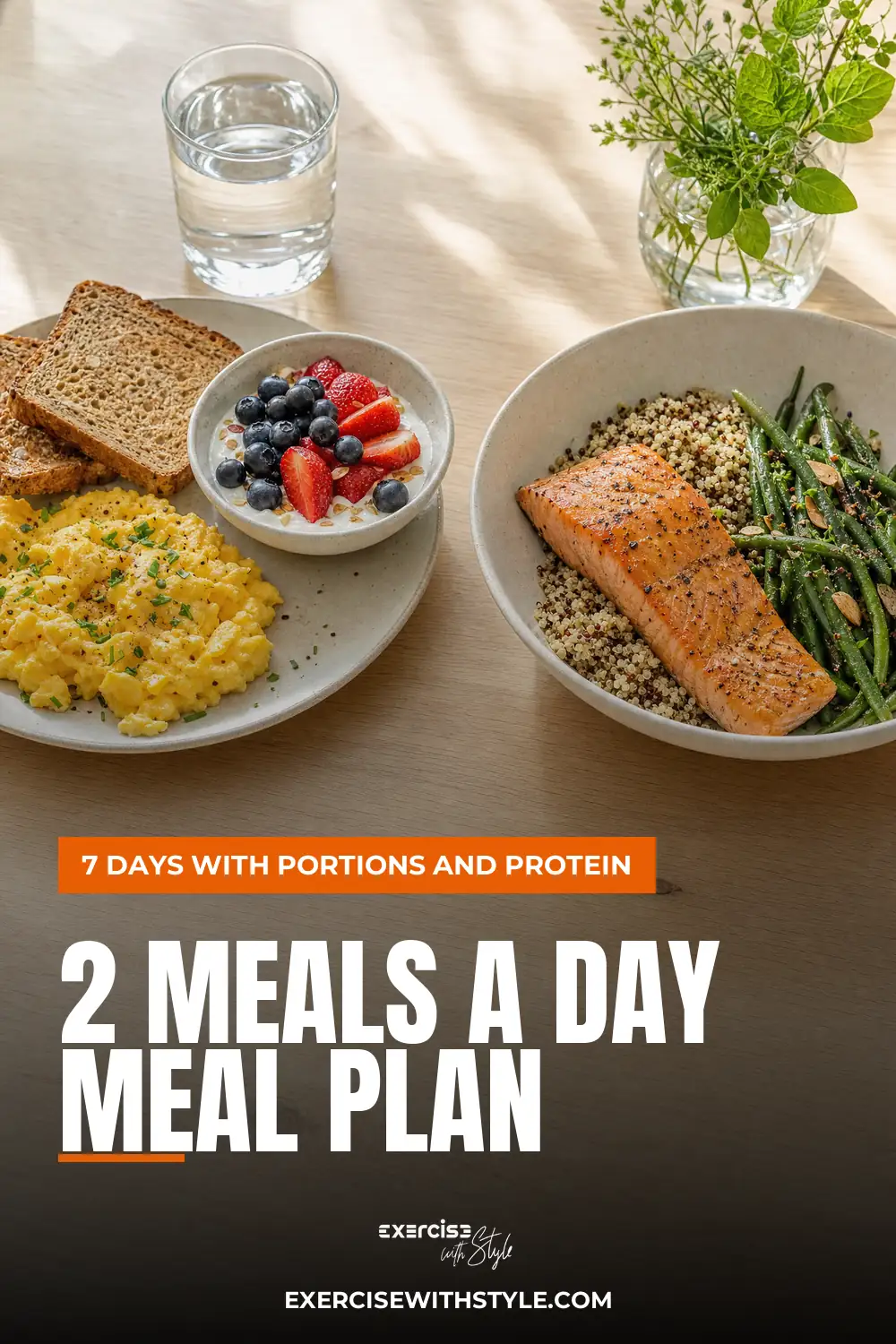
You get to choose the times. Pick the two that fit your day, and stick to them most days. Some people eat breakfast and an early dinner. Others skip breakfast and eat lunch and dinner. Both work!
The 7 day plan
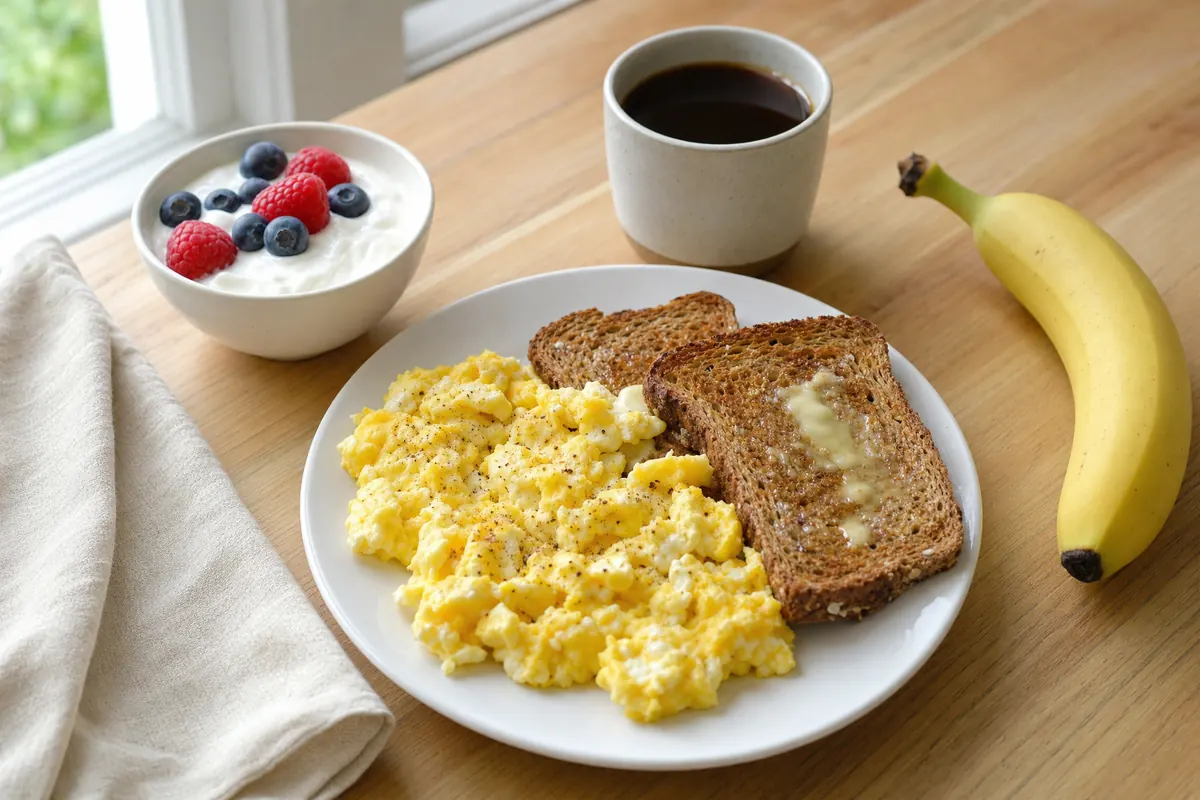
All values are approximate, worked out from USDA FoodData Central for the exact portions listed. Weigh rice, pasta, potatoes, meat and fish after cooking, unless it says raw.
Day 1
| Meal | What to eat | Calories | Protein |
|---|---|---|---|
| Meal 1 | 4 eggs scrambled in a non-stick pan, 2 slices whole grain toast with 1 tsp butter, 150 g 0% Greek yogurt with 80 g berries, 1 banana | ~750 | ~50 g |
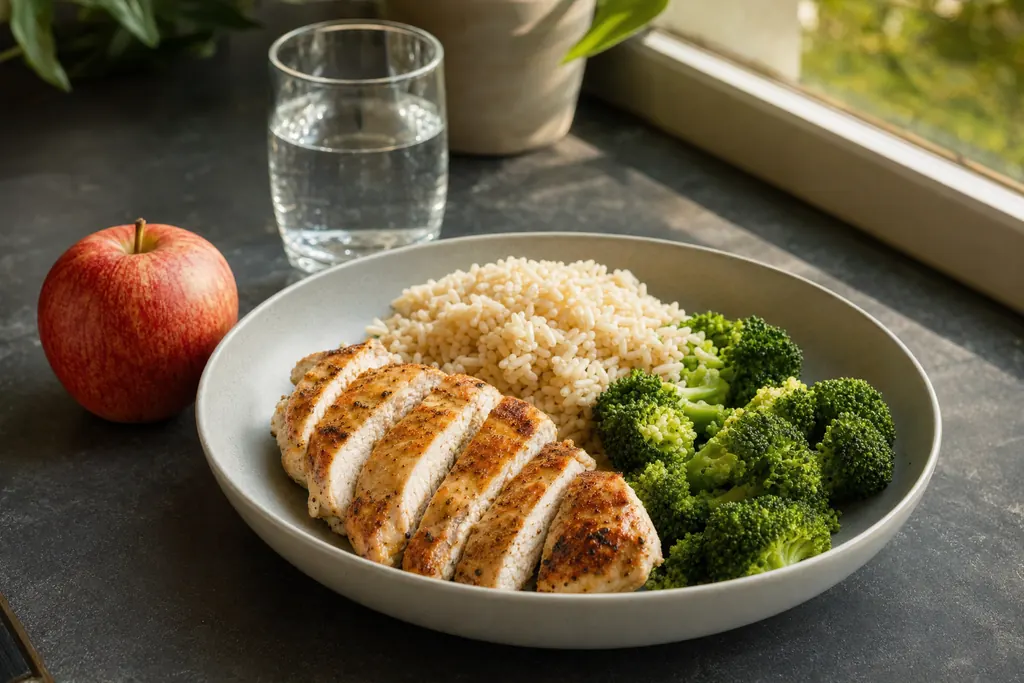
| Meal 2 | 180 g grilled chicken breast, 200 g cooked brown rice, 150 g broccoli, 1 tbsp olive oil, 1 apple | ~810 | ~65 g |
| Day total | ~1,560 | ~115 g |
Day 2
| Meal | What to eat | Calories | Protein |
|---|---|---|---|
| Meal 1 | 80 g oats cooked in 1 cup (250 ml) 2% milk, 1 scoop (30 g) whey protein stirred in, 1 sliced banana, 15 g peanut butter | ~730 | ~45 g |
| Meal 2 | Tuna wrap: 1 can (120 g drained) tuna, 1 tbsp light mayo, salad in a large whole wheat tortilla. 2 boiled eggs, 200 g new potatoes, side salad with 1 tbsp olive oil | ~790 | ~45 g |
| Day total | ~1,520 | ~90 g |
Day 3
| Meal | What to eat | Calories | Protein |
|---|---|---|---|
| Meal 1 | 200 g 0% Greek yogurt with 40 g granola, 100 g berries and 1 tbsp honey. 2 boiled eggs, 1 slice whole grain toast, 20 g almonds | ~790 | ~45 g |
| Meal 2 | Beef stir-fry: 200 g lean (5% fat) beef strips (raw weight), 200 g stir-fry vegetables, 1 tbsp oil, soy sauce and ginger, 200 g cooked rice noodles. 1 orange | ~810 | ~55 g |
| Day total | ~1,600 | ~100 g |
Day 4
| Meal | What to eat | Calories | Protein |
|---|---|---|---|
| Meal 1 | Banana oat pancakes (2 eggs, 50 g oats and 1 banana blended, then fried in a non-stick pan), 150 g 0% Greek yogurt, 80 g berries, 1 tsp maple syrup, 2 slices turkey bacon | ~710 | ~45 g |
| Meal 2 | 170 g baked salmon fillet, 180 g cooked quinoa, 150 g green beans with 1 tsp olive oil. For afters: 150 g cottage cheese with 80 g pineapple | ~810 | ~65 g |
| Day total | ~1,520 | ~110 g |
Day 5
| Meal | What to eat | Calories | Protein |
|---|---|---|---|
| Meal 1 | 2 slices whole grain toast with 2 tbsp peanut butter and 1 sliced banana. 1 1/4 cups (300 ml) 2% milk blended with 1 scoop whey | ~720 | ~50 g |
| Meal 2 | 2 turkey and cheese wraps (2 whole wheat tortillas, 120 g sliced turkey breast, 40 g cheddar, salad). 100 g carrot sticks with 50 g hummus | ~850 | ~55 g |
| Day total | ~1,570 | ~105 g |
Day 6
| Meal | What to eat | Calories | Protein |
|---|---|---|---|
| Meal 1 | 250 g low-fat cottage cheese with 150 g pineapple. 2 slices whole grain toast with 1 tbsp almond butter. 2 boiled eggs | ~670 | ~55 g |
| Meal 2 | 160 g grilled pork loin chop, 250 g roasted sweet potato with 1 tsp oil, 150 g asparagus, 1 apple. 30 g dark chocolate | ~850 | ~55 g |
| Day total | ~1,520 | ~110 g |
Day 7
| Meal | What to eat | Calories | Protein |
|---|---|---|---|
| Meal 1 | Whole wheat English muffin with 3 eggs scrambled in a non-stick pan and 30 g grated cheese, half a grapefruit, 150 g 0% Greek yogurt, 1 banana | ~720 | ~50 g |
| Meal 2 | Tofu stir-fry: 200 g firm tofu, 200 g mixed vegetables, 1 tbsp oil, 1 tbsp soy sauce, 20 g peanuts, 150 g cooked brown rice | ~850 | ~50 g |
| Day total | ~1,570 | ~100 g |
How to scale it to you
The plan sits at about 1,500 to 1,600 calories a day. That suits many smaller women who want to lose weight.
Most men, and anyone taller or very active, will need more. Here’s how to adjust it:
| You need about | Do this |
|---|---|
| 1,300 to 1,400 a day | Drop the fruit and the fat added at cooking (butter, oil, nut butter) from one meal |
| 1,800 a day | Add about 120 to 130 calories to each meal: 40 g extra cooked rice or 1 more slice of toast, plus 1 tsp oil or a small handful of nuts |
| 2,000 to 2,200 a day | Add about 250 calories to each meal: double the carb portion (rice, potatoes, oats, bread) and add 50 g more of the protein |
Not sure what you need? A plan built around your number is easier to follow. Try the 1,200, 1,800 or 2,000 calorie meal plan and squeeze the meals into two.
How to build your own two meal day
Want to swap meals around? Easy. Just make sure each meal has these four things:
- A big protein portion: 40 to 60 g. Chicken, fish, lean beef, pork loin, eggs, Greek yogurt, cottage cheese, tofu or whey. This is the part people most often get wrong, and the next section explains why it matters more on two meals.
- A carb you like. Rice, potatoes, oats, bread, pasta or quinoa.
- Vegetables or fruit. At least one generous portion per meal.
- A little fat. Oil for cooking, nuts, cheese or peanut butter. It adds up fast, so it’s worth measuring.
Does two meals a day help you lose weight?
Only by helping you eat less. Here’s what the research says, without the spin.
Eating more often doesn’t speed up fat loss. That idea has been around for decades. But when researchers pooled 15 studies on meal frequency, the apparent benefit of eating more often came down to a single study. Take that one out, and it disappears.
Eating less often doesn’t speed it up either. A 2023 review of 16 trials found no difference in weight change between three or fewer meals a day and four or more. The studies weren’t great quality, but they point the same way.
Squeezing your eating into a window isn’t magic. In a year-long trial of 139 people with obesity, everyone ate the same reduced calories. Those who ate only between 8am and 4pm didn’t lose significantly more weight or fat than those who ate across the whole day.
So what decides it? Total calories. Two meals a day helps if it makes eating less easier for you.
For lots of people it does: no snacking, fewer decisions, and bigger meals that actually fill you up. For others, it leads to overeating at night. Give it two weeks, and be honest with yourself about which one you are.
What about the diabetes study?
You might see a 2014 study quoted as proof that two meals beats six. In that trial of 54 people with type 2 diabetes, eating the same calories as breakfast and lunch only did lead to more weight loss than six small meals: 8.2 lb (3.7 kg) against 5.1 lb (2.3 kg) over 12 weeks.
But that was a specific group, on a reduced-calorie diet, eating both meals early in the day. It doesn’t mean two meals works better for everyone. And if you have diabetes, please only change your meal timing with your doctor’s help.
The one real downside: protein
This is the trade-off nobody seems to mention.
To keep your muscle, especially if you train, aim for 0.6 to 0.9 g of protein per pound of bodyweight a day (1.4 to 2.0 g per kg). For a 143 lb (65 kg) person, that’s about 90 to 130 g.
On two meals, each one has to carry half of that. Researchers who reviewed how much protein a single meal can usefully deliver suggest about 0.18 g per pound (0.4 g per kg) per meal, spread over at least four meals. Two meals can’t follow that pattern.
The good news? The same review found that protein above about 20 g in one meal isn’t simply wasted, so big protein meals still count.
So what should you do? If your goal is mainly weight loss, two protein-heavy meals is fine, and that’s exactly how this plan is built. If your main goal is building muscle, four meals is the better pattern, and our guide to the best foods to gain muscle will help.
Questions people ask
Can I drink coffee in the morning?
Yes! Black coffee, tea and water are fine at any time, and a splash of milk is fine too. Just know that a large latte is really a small meal.
What if I get hungry between meals?
That’s really common in the first week. Drink some water and wait it out. If you’re still struggling by week two, move your meals closer together, or add a high protein snack like Greek yogurt. Three meals isn’t failure!
Can I work out on two meals a day?
Yes. Try to train before one of your meals, so you eat afterwards. If you lift, keep your protein at the top of the range.
Is this the same as intermittent fasting?
It’s a form of it. For the bigger picture, take a look at intermittent fasting for beginners, or the 7 day intermittent fasting meal plan if you’d rather eat in a window with more than two meals.
Does skipping meals “confuse” your metabolism?
Nope. That idea gets sold a lot, but our article on the metabolic confusion diet explains why it doesn’t hold up.
Happy eating, and enjoy the simplicity!
This article is for general information and is not medical advice. Talk to your doctor before changing how you eat if you take medication for diabetes or blood pressure, are pregnant or breastfeeding, have a history of disordered eating, or have any medical condition.
