

What's inside
Long days at a desk can leave your back feeling tired and your middle feeling weak. You don’t need a gym, or a single crunch, to start changing that.
This back and core workout uses five floor moves that train your whole middle: the front, the sides and the back. There’s no equipment and no jumping. Plan on about 13 minutes at first, building to about 30 by week 5.
Keep reading for each move step by step, with an easier and a harder version, a 6 week plan, and the signs that mean you should stop and get your back checked.
Your core is more than your abs
Your core is a ring of muscle around your middle. Your abs sit at the front. Your obliques, or the muscles along your sides, wrap around your waist. And long muscles run down your back on either side of your spine.
Why does that matter? Crunches and sit-ups mostly train the front, so half the ring gets left out. This routine works all of it: the two planks train the front and sides, and the other three moves train your back.
Warm-up (2 minutes)
Use a mat or a folded towel.
- Cat cow, 8 slow reps. On hands and knees, round your back up toward the ceiling, then let your stomach sink and lift your chest. Move with your breath.
- Thread the needle, 5 per side. Still on hands and knees, slide one arm along the floor under your body and let your shoulder and head follow. Come back up and switch.
- Child’s pose, 30 seconds. Sit your hips back toward your heels, arms long in front of you, and breathe slowly.
The 5 back and core moves
Each move has three levels. Start at Level 1 and move up once your current level feels steady and easy.
1. Bird dog
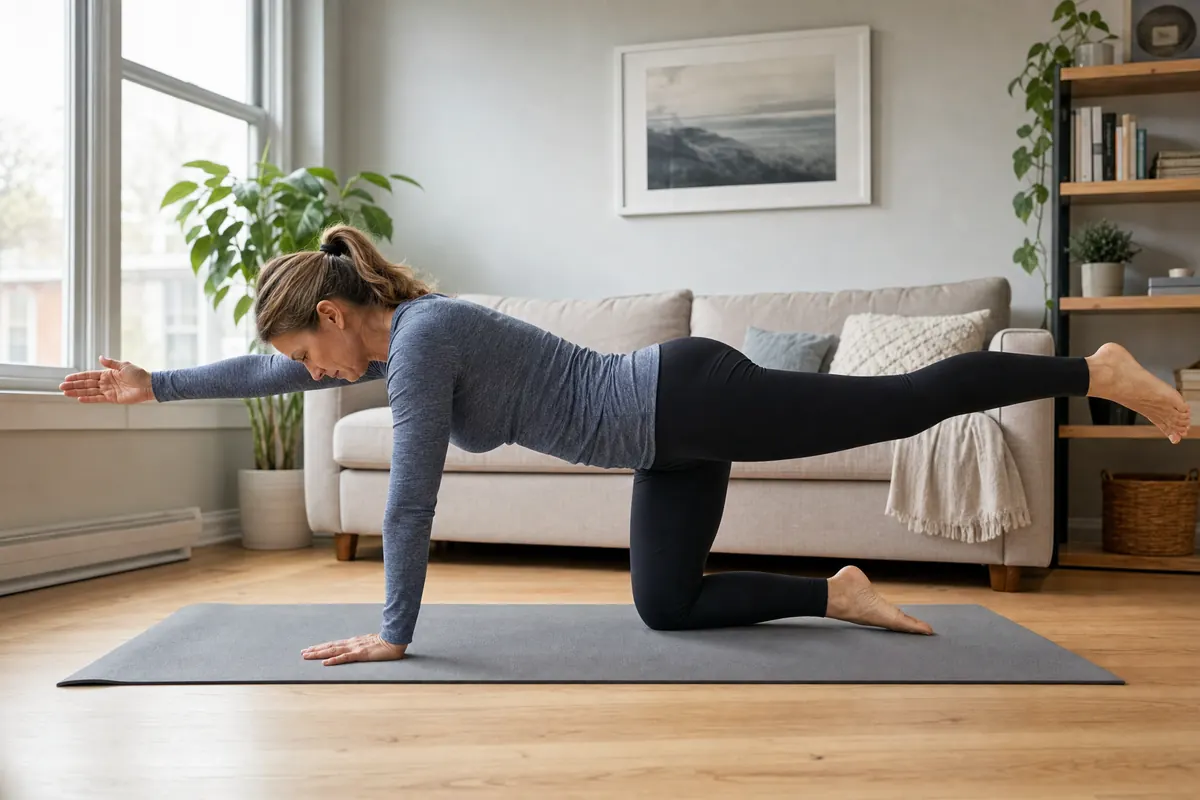
Works: your lower back, glutes (your butt muscles) and the deep core muscles that hold you steady.
On hands and knees, line up your hands under your shoulders and your knees under your hips. Reach one arm forward and the opposite leg straight back until both are level with your body. Return and switch sides.
- Level 1: arm only, then leg only
- Level 2: opposite arm and leg together, hold 2 seconds
- Level 3: hold 5 seconds and move slowly
Watch for: your hips tipping to one side. Imagine balancing a cup of water on your lower back.
2. Prone Y raise
Works: your upper and middle back, and the backs of your shoulders.
Lie prone, or face down, with your arms stretched overhead in a Y shape and your thumbs pointing up. Squeeze your shoulder blades down and back, then lift your arms a few inches off the floor. Lower slowly.
- Level 1: a small lift
- Level 2: lift and hold 2 seconds
- Level 3: lift and hold 5 seconds
Watch for: shrugging toward your ears or lifting your head. Keep your neck long and your eyes on the floor.
3. Forearm plank
Works: your whole core, especially the front.
Rest on your forearms with your elbows under your shoulders. Make a straight line from your head to your heels (or knees). Squeeze your glutes and brace your stomach, as if someone were about to poke it.
- Level 1: from your knees
- Level 2: from your toes
- Level 3: from your toes, lifting one foot at a time
Watch for: your lower back sagging. If it does, drop to your knees for the rest of the set.
4. Side plank
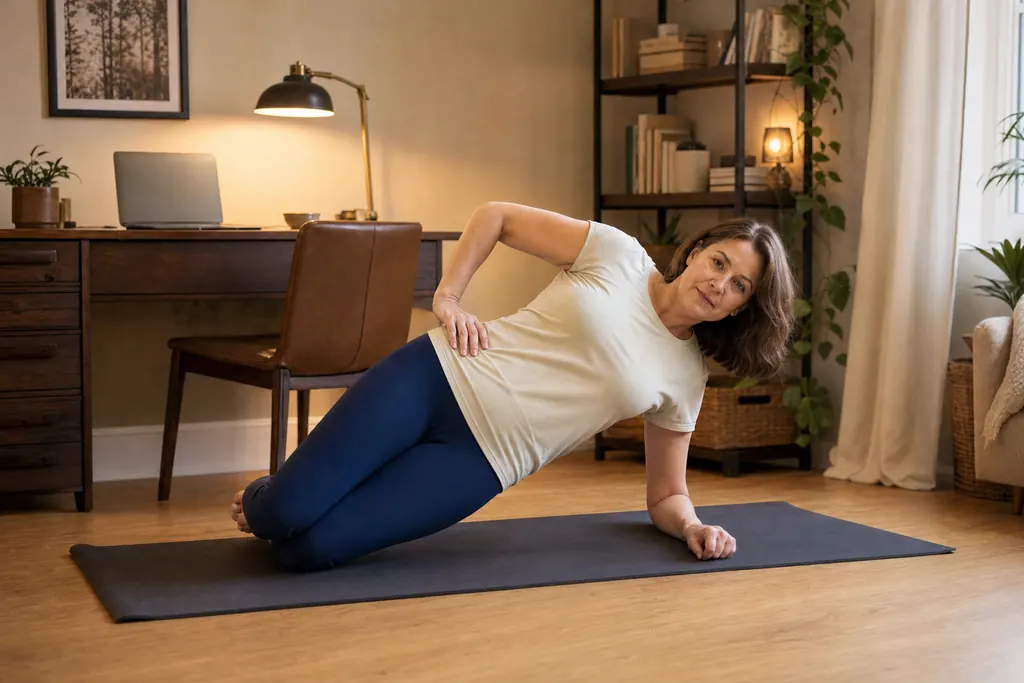
Works: your obliques and the sides of your hips.
Lie on your side with your elbow under your shoulder. Lift your hips so your body makes a straight line, hold, then switch sides.
- Level 1: knees bent, lifting from your knees
- Level 2: legs straight, lifting from your feet
- Level 3: from your feet, with your top leg lifted
Watch for: your hips drifting back. Keep them stacked one over the other.
5. Superman hold
Works: the whole back of your body, from your upper back to your glutes.
Lie face down with your arms overhead. Lift your chest, arms and legs a few inches off the floor at the same time, squeezing your glutes. Hold, then lower.
- Level 1: lift your chest and arms only
- Level 2: lift your chest, arms and legs
- Level 3: chest, arms and legs, with small flutter kicks
Watch for: cranking your head up. Keep the lift small; this isn’t a backbend.
From our shopOur 30-Day Home-Based Workout Program gives you 4 home workouts a week, and each week builds a little on the last.
Your 6 week plan
Do the five moves in order. That’s one round. Rest 30 seconds between moves and 60 seconds between rounds. Two or three sessions a week, with a rest day in between, works well.
| Move | Weeks 1 to 2 | Weeks 3 to 4 | Weeks 5 to 6 |
|---|---|---|---|
| Bird dog | 8 per side | 10 per side | 10 per side, Level 3 |
| Prone Y raise | 10 | 12 | 12, Level 3 |
| Forearm plank | 20 seconds | 30 seconds | 45 seconds |
| Side plank | 15 seconds per side | 25 seconds per side | 35 seconds per side |
| Superman hold | 5 x 3 seconds | 6 x 5 seconds | 8 x 5 seconds |
| Rounds | 2 | 3 | 3 |
| Time, with warm-up | About 13 minutes | About 23 minutes | About 30 minutes |
How hard should it feel? The last few reps or seconds of each set should feel challenging, while you can still keep good form. If a move feels easy two sessions in a row, try the next level.
Short on time? At the week 1 level, one round of the five moves, with its rests, takes about 5 minutes. It keeps the habit going.
Can exercise help back pain?
If your lower back has hurt for 3 months or more, exercise is a well-studied treatment. A Cochrane review, or a large summary of the research, pooled 249 trials of adults with long-term low back pain.
Compared with no treatment, usual care or a placebo (a fake treatment), exercise eased pain by about 15 points on a 100 point scale. The reviewers count that as a difference big enough to matter. The side effects people reported were mostly minor, like sore muscles.
Two things to keep in mind. Those trials used many kinds of exercise, not this exact routine. And if you have back pain right now, ask a physical therapist which of these moves suit you before you start.
Back pain: when to stop
Mild muscle tiredness in your back after these moves is normal. Stop and see a doctor or physical therapist if you have:
- Sharp or shooting pain, or pain that travels down a leg
- Numbness or tingling
- Pain that gets worse with each workout rather than better
Call 911 or go to the emergency room if back pain comes with numbness, tingling or weakness in both legs, loss of feeling around your genitals or bottom, or changes in your bladder or bowels. The NHS lists these as emergency signs.
Make it part of your week
Add the rest of your body. The WHO recommends strength work for all your major muscle groups at least two days a week. This routine covers your back and core, so pair it with a leg and upper body workout.
Break up your sitting. The WHO advises adults to limit sedentary time, or time spent sitting or lying with little movement while awake. It says swapping that time for movement of any intensity, even light, has health benefits. Our suggestion: get up every 30 to 60 minutes, roll your shoulders back and walk for a minute or two.
Questions
Can I do this every day?
At Level 1, yes. As the moves get harder, keep a rest day between sessions.
Will this fix my posture?
We can’t promise that. What this routine does is strengthen the muscles along your back and sides. Getting up from your desk often helps too.
Can I add weights?
Once Level 3 feels easy, our at-home back workout guide has dumbbell and band moves to build on this. For more upper back work, try these middle back exercises.
Should I add crunches?
You don’t need them for this plan. If you want more ab work, try our upper and lower ab exercises on another day.
What if I only have 10 minutes in the morning?
Try our 10 minute morning workout, then come back to this one on your next free evening.
Here’s to a stronger middle! Start at Level 1 this week, and tell us in the comments how your first session goes.
This article is for general information and is not medical advice. If you have back pain, a back injury, osteoporosis, are pregnant, or have a medical condition, check with a doctor or physical therapist before starting.
