

What's inside
This running program is for people who have never run, or have not run in years. You start by running for just one minute at a time, with walking breaks. Nine weeks later, you run for 30 minutes without stopping.
You run three times a week. Each session takes 30 to 40 minutes, including a warm-up walk and a cool-down. If a week feels too hard, you repeat it. There is no rush.
The plan at a glance
| Length | 9 weeks (longer is fine) |
| Runs per week | 3, never on back-to-back days |
| Session length | 30 to 40 minutes including warm-up and cool-down |
| Start | 1 minute running, 2 minutes walking |
| Finish | 30 minutes of running without stopping |
| Pace | Slow enough to talk in short sentences |
| Equipment | Running shoes and a timer (a free interval app works well) |
The 9 week running program

Every session starts with a 5 minute brisk walk and ends with a 5 minute easy walk. The table shows the middle part, the running workout.
| Week | Each session (all 3 runs) | Total running |
|---|---|---|
| 1 | Run 1 min, walk 2 min. Repeat 8 times | 8 min |
| 2 | Run 1 min 30 sec, walk 2 min. Repeat 7 times | 10 min 30 sec |
| 3 | Run 2 min, walk 2 min. Repeat 6 times | 12 min |
| 4 | Run 3 min, walk 2 min. Repeat 5 times | 15 min |
| 5 | Run 4 min, walk 1 min 30 sec. Repeat 4 times | 16 min |
| 6 | Run 5 min, walk 1 min 30 sec. Repeat 4 times | 20 min |
| 7 | Run 8 min, walk 2 min. Repeat 3 times | 24 min |
| 8 | Runs 1 and 2: run 12 min, walk 2 min, run 12 min. Run 3: run 20 min non-stop | 20 to 24 min |
| 9 | Run 1: 25 min. Run 2: 28 min. Run 3: 30 min non-stop | 25 to 30 min |
A sample week: Monday, Wednesday, Saturday. Walk, rest or do a short strength session on the other days.
The pace rule: slower than you think
A classic beginner mistake is running too fast. You are not trying to run fast. You are trying to run for longer.
The talk test. While running, you should be able to say a short sentence out loud, like “I am doing fine.” If you can only gasp one word, slow down. If you can sing, speed up a little.
Your running pace might be barely faster than a brisk walk. That is completely normal and it still counts as running.
When to repeat a week
Repeat the week if any of these happen:
- You could not finish the last running interval on two of the three runs
- You were still very sore two days later
- Something hurt in the “yellow” or “red” way (below)
Repeating a week is not failing. Taking 12 or 14 weeks to reach 30 minutes is completely fine, and you still get there.
From our shopOur 30-Day Home-Based Workout Program gives you 4 home workouts a week, and each week builds a little on the last.
Pain: the traffic light
| Light | What you feel | What to do |
|---|---|---|
| Green | General tired legs, mild muscle soreness the next day that fades | Keep going with the plan |
| Yellow | A dull ache in one spot (shin, knee, foot) that eases as you warm up but returns afterward | Rest 2 or 3 days, then repeat the previous week. If it comes back, see a professional |
| Red | Sharp pain, pain that gets worse as you run, limping, swelling | Stop running and get it checked |
Here is why we take this seriously. New runners get injured more than twice as often per hour of running as people who already run regularly. That is why this plan builds up slowly, even on days you feel ready for more.
What about the 10% rule? You may have heard you should never add more than 10% a week. In a trial of 532 new runners, a slower 13 week plan built on that rule did not lead to fewer injuries than a standard 8 week plan. About 1 in 5 runners got hurt either way. That does not mean you should rush. It means no rule replaces listening to the warning signs above.
Before your first run
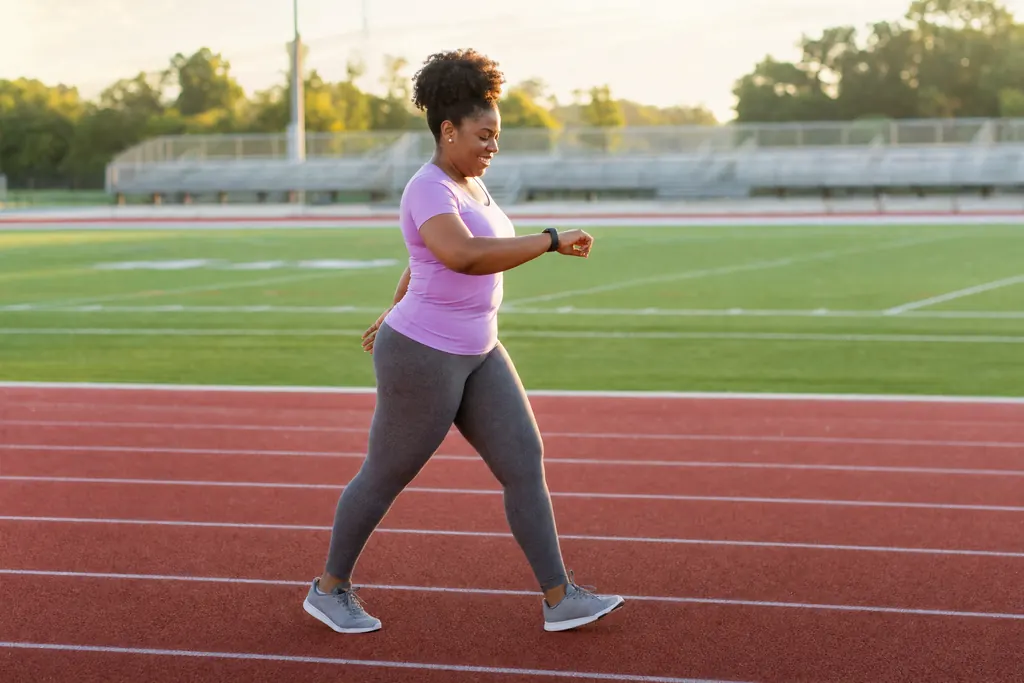
Shoes. Go to a running store if you can and try a few pairs. Comfort is the best guide. If you are a bigger runner, our guide to running shoes for heavy female runners is a good starting point.
Where to run. Flat and easy: a park path, a track or a quiet loop. Hills come later.
Treadmill? Absolutely fine. You may hear that you should set a 1% incline to match running outside. That tip comes from a study of trained runners, and at the two slowest speeds they tested (still quicker than most beginners run), a flat treadmill matched the road too. At a beginner’s pace, flat is fine.
Timer. A free interval timer app beeps when to run and when to walk, so you do not have to watch the clock.
Make it easier on your body
- Short strides. Take quick, light steps rather than long bounding ones. Land with your foot under your body, not out in front.
- Relax your shoulders. Hands loose, arms swinging forward and back.
- Strength train twice a week. The WHO recommends strength work on two or more days a week, and it may protect you too. In a review of 25 trials across many sports (not just running), strength training programs cut injuries to less than a third. Squats, lunges, glute bridges and calf raises are a good start; our bodyweight workout plan for beginners covers them.
- Sleep and eat normally. A new running habit is not the time for a crash diet.
After week 9
You can now run for 30 minutes. Some next steps:
- Run a 5K. That is 5 km, or 3.1 miles. Depending on your pace it may take a little longer than 30 minutes, and a short walk break on race day is completely fine. Signing up for a local event is a great motivator.
- Keep three runs a week and make one of them a little longer each week.
- Combine with walking. Three 30 minute runs plus two brisk 30 minute walks reaches the WHO’s 150 minutes a week of activity.
Running for weight loss? Read does running burn belly fat for what to expect. If running is not for you, low impact cardio works too.
Questions
Can I run every day to get there faster?
No. Rest days let your legs adapt. Three runs a week is the plan for a reason.
I’m overweight. Can I still follow this?
Yes. Go slowly, repeat weeks freely, and consider walking briskly for two weeks before you start. Check with your doctor first if you have joint, heart or blood pressure concerns.
My shins hurt.
Mild soreness that fades within a day or two is in the green zone of the traffic light above. Sharp or worsening pain is not. Also check that you are not overstriding or running too fast.
Should I stretch before running?
You do not need to. The 5 minute brisk walk is your warm-up, and in the same review of 25 trials, stretching did not prevent injuries. Gentle stretching afterward is fine if it feels good.
I missed a week.
Go back one week and carry on from there.
This article is for general information and is not medical advice. If you have a heart condition, high blood pressure, joint problems, are pregnant, or have been inactive for a long time, check with a doctor before starting to run.
